
Best Cleveland Traffic Ticket Lawyers: 2026 Comparison Guide

Receiving a traffic ticket may seem like a minor inconvenience, but the consequences can extend well beyond paying a fine. Depending on the violation, a citation may result in points on your driver's license, higher insurance premiums, license suspension, mandatory court appearances, commercial driver's license consequences, or even criminal charges.
Choosing the right attorney can make an important difference in how your case is handled.
Not every traffic ticket lawyer approaches these cases the same way. Some focus on resolving straightforward citations efficiently, while others routinely handle criminal traffic offenses involving reckless operation, driving under suspension, hit-skip allegations, and other serious violations. Differences in courtroom experience, evidence review, communication, local court knowledge, and trial preparation can all influence how a case progresses.
This guide compares several Cleveland law firms that publicly advertise traffic tickets and criminal traffic defense services. Rather than ranking attorneys or claiming one firm is objectively the best, the goal is to help drivers understand what factors genuinely matter when comparing legal representation.
Whether you received a speeding ticket, were charged with reckless operation, or are facing a more serious traffic-related offense, asking the right questions before hiring an attorney can help you make a more informed decision.
What Should You Compare Before Hiring a Cleveland Traffic Ticket Lawyer?
Many drivers choose an attorney based solely on online reviews or the lowest quoted fee. While those factors may be worth considering, they rarely tell the full story.
Traffic cases can vary significantly depending on the alleged violation, the available evidence, and whether the offense carries criminal penalties. Comparing lawyers based on meaningful criteria can help you make a more informed decision.
Experience Handling Your Specific Traffic Violation
Not every traffic offense is alike.
An attorney who regularly handles speeding tickets may approach a case differently than one involving reckless operation, driving under suspension, or leaving the scene of an accident.
When comparing attorneys, ask whether they regularly represent drivers charged with:
- Speeding violations
- Reckless operation
- Driving under suspension
- Failure to control
- Failure to stop after an accident
- Hit-skip allegations
- Commercial driver's license violations
- Driving without a valid license
- Traffic offenses involving accidents
Experience with your specific charge often matters more than simply asking how long someone has practiced law.
Familiarity With Cleveland and Cuyahoga County Courts
Traffic laws are governed by Ohio law, but local courts often have their own procedures, scheduling practices, and administrative requirements.
Lawyers who regularly appear in Cleveland Municipal Court and other Cuyahoga County courts are generally familiar with local filing deadlines, courtroom procedures, scheduling practices, and the progression of traffic cases.
Local experience does not guarantee a particular result.
However, understanding how cases typically move through local courts can help attorneys prepare more effectively.
Communication Throughout Your Case
Many drivers have never been to traffic court before.
They often have practical questions, such as:
- Will I have to appear in court?
- Can I continue driving?
- Will points be added to my license?
- What happens if I miss my court date?
- How long will the case take?
Ask prospective attorneys how communication works throughout the case.
Will you primarily communicate with the attorney?
Will another lawyer or staff member appear in court?
Who will answer questions if new issues arise?
Knowing what to expect can reduce uncertainty during the legal process.
Evidence Review
Some traffic cases involve far more evidence than drivers expect.
Depending on the charge, an attorney may review:
- Police reports
- Dash camera footage
- Body camera recordings
- Radar or LIDAR records
- Witness statements
- Accident reports
- Photographs
- Surveillance footage
- Vehicle damage
- Officer notes
A careful review of the available evidence may identify inconsistencies, factual disputes, or legal issues that are not immediately apparent after receiving a citation.
Trial Preparation
Although many traffic cases resolve before trial, preparation still matters.
Attorneys who prepare thoroughly from the beginning are often better positioned to evaluate evidence, negotiate effectively, and present a strong defense if litigation becomes necessary.
Preparing for trial does not mean every case should go to trial.
It means being ready if that becomes the most appropriate course of action.
Fees and What They Include
Legal fees vary depending on the seriousness of the offense and the amount of work required.
Before hiring an attorney, ask exactly what the quoted fee includes.
For example:
- Court appearances
- Negotiations
- Motion practice
- Trial preparation
- License suspension hearings
- Appeals, if necessary
Comparing fees without understanding the scope of representation can lead to misunderstandings later.
Reputation and Professionalism
Reviews can provide helpful insight, but they should not be the only factor guiding your decision.
Instead of focusing on a single review, look for recurring themes such as:
- Communication
- Preparation
- Professionalism
- Knowledge of Ohio traffic law
- Responsiveness
- Overall client experience
Patterns over time are generally more meaningful than isolated comments.
Questions Worth Asking Every Traffic Ticket Lawyer
Before making a decision, consider asking:
- Have you handled cases like mine before?
- Who will personally appear in court?
- What evidence will you review?
- What are the strongest and weakest parts of my case?
- What possible outcomes should I realistically expect?
- Are there legal defenses worth exploring?
- What does your fee include?
- Are you prepared to take my case to trial if necessary?
The answers often provide a better understanding of an attorney's approach than advertising alone.
Why Local Court Experience Matters in Cleveland Traffic Cases
Ohio traffic laws apply throughout the state, but every court has its own procedures, scheduling practices, and administrative expectations.
An attorney handling a traffic case in Cleveland Municipal Court may encounter different local practices than one appearing in another Ohio jurisdiction. While judges must apply Ohio law consistently, court schedules, motion deadlines, diversion opportunities when available, and case management procedures often differ from court to court.
Likewise, prosecutors may approach negotiations differently depending on the type of offense, the driver's history, and the available evidence.
Hiring a lawyer who regularly appears in Cleveland and Cuyahoga County courts does not guarantee a particular outcome. However, familiarity with local procedures can help an attorney prepare more efficiently, anticipate potential issues, and guide clients through the process with fewer surprises.
When Does a Traffic Ticket Become a Criminal Case?
One of the biggest misconceptions about traffic violations is that every ticket is simply a civil matter that can be resolved by paying a fine.
That is not always true.
While many traffic citations are classified as minor misdemeanors, others are criminal offenses that may carry additional penalties beyond fines.
Examples of traffic-related criminal charges in Ohio include:
- Reckless operation
- Driving under suspension
- Failure to stop after an accident (hit-skip)
- Fleeing or eluding law enforcement
- Operating a vehicle under the influence (OVI)
- Driving without a valid license in certain circumstances
- Vehicular assault or vehicular homicide in more serious incidents
Criminal traffic offenses can result in probation, jail time, driver's license suspensions, points, increased insurance premiums, and a permanent criminal record.
Understanding the classification of your charge is often one of the first questions to discuss with an attorney.
Why Acting Quickly After Receiving a Traffic Citation Matters
Many drivers believe there is little to do after receiving a ticket except wait for the court date.
In reality, some of the most important work may begin immediately.
Evidence can disappear.
Witnesses become harder to locate.
Surveillance footage may be overwritten.
Dash camera recordings may not be preserved indefinitely.
The sooner an attorney becomes involved, the sooner important evidence can be identified and preserved.
Depending on the circumstances, this may include:
- Police body camera recordings
- Patrol vehicle dash camera footage
- Surveillance video from nearby businesses
- Traffic camera footage
- Witness statements
- Photographs of the accident scene
- Vehicle damage documentation
- Dispatch recordings
Waiting several weeks before seeking legal advice may make recovering important evidence significantly more difficult.
What Happens After Receiving a Traffic Ticket in Ohio?
Many drivers are unsure what happens after receiving a citation.
Although every case is different, a traffic case often follows a similar process:
- Citation is issued
- Court date is scheduled, when required
- Evidence is reviewed
- Negotiations may occur
- Pretrial hearings, if applicable
- Trial, if necessary
- Resolution through dismissal, amendment, plea agreement, or judgment
Understanding the process can help drivers ask better questions when comparing Cleveland traffic ticket lawyers and deciding how to respond to a citation.
What Evidence Can Affect a Traffic Ticket Case?
Not every traffic citation depends solely on the officer's observations.
Many modern traffic cases involve multiple forms of evidence that must be reviewed together.
Police Reports
The officer's written report often forms the foundation of the prosecution's case.
These reports typically summarize:
- The alleged violation
- Driving behavior
- Road and weather conditions
- Statements made by the driver
- Witness information
- Any physical evidence observed
While police reports are important, they are not the only evidence that may be considered.
Radar and LIDAR Evidence
Speeding cases frequently involve radar or LIDAR devices.
Questions that sometimes arise include:
- Was the equipment properly calibrated?
- Was it maintained according to required procedures?
- Was the officer trained to operate the device?
- Were environmental conditions a factor?
- Was the correct vehicle identified?
Reviewing how speed measurements were obtained may be an important part of evaluating a speeding citation.
Dash Camera and Body Camera Footage
Many law enforcement agencies record traffic stops using both dash cameras and body cameras.
These recordings may document:
- The driving behavior that led to the stop
- The officer's observations
- Statements made during the stop
- Road conditions
- Weather
- Traffic volume
- Interactions between the driver and law enforcement
Video evidence sometimes confirms the written report.
In other cases, it provides additional context or raises questions that are not apparent from the report alone.
Witness Statements
Some traffic cases involve independent witnesses.
These individuals may provide information about:
- Vehicle speed
- Lane position
- Traffic signals
- Driver behavior
- Road conditions
- The sequence of events leading to an accident
Witness credibility often becomes an important consideration when multiple accounts differ.
Surveillance Footage
Businesses, homes, parking lots, and traffic intersections increasingly rely on surveillance systems.
These recordings may capture:
- Vehicle movements
- Traffic signal changes
- Lane changes
- Pedestrian activity
- The collision itself
Because many systems automatically overwrite footage after a limited period, preserving this evidence quickly can be important.
Accident Reconstruction
For more serious traffic offenses involving collisions, investigators may analyze:
- Vehicle damage
- Skid marks
- Roadway measurements
- Debris patterns
- Vehicle positioning
- Photographs
- Electronic vehicle data
Accident reconstruction may become relevant when the facts surrounding a crash are disputed.
License Points and Insurance Consequences
Many drivers focus only on the fine printed on the citation.
However, the long-term consequences may be far more significant.
Depending on the violation, a conviction may result in:
- Points on your Ohio driver's license
- Increased insurance premiums
- Driver's license suspension
- Commercial driver's license consequences
- Mandatory remedial driving courses
- Difficulty obtaining certain employment opportunities
For commercial drivers, even relatively minor violations can have professional consequences that extend well beyond the courtroom.
Understanding these collateral consequences is an important part of deciding how to respond to a traffic citation rather than automatically paying the ticket.
Constitutional Issues May Also Affect Traffic Cases
Traffic stops are subject to constitutional protections.
Depending on the circumstances, legal questions may include:
- Was the traffic stop lawful?
- Did the officer have reasonable suspicion?
- Was evidence obtained through an unlawful search?
- Were statements obtained in violation of constitutional rights?
- Was the detention longer than legally justified?
When constitutional concerns arise, attorneys may evaluate whether motions challenging portions of the evidence are appropriate.
Not every traffic case involves constitutional litigation.
However, these issues can become significant in certain criminal traffic prosecutions involving more serious allegations.
Comparing Some of Cleveland's Leading Traffic Ticket Law Firms
Choosing a traffic ticket lawyer involves more than finding someone who advertises traffic defense services. Every attorney has a different approach to preparing cases, reviewing evidence, negotiating with prosecutors, and representing clients in court.
The firms below publicly advertise traffic ticket and criminal traffic defense services in or around Cleveland. This comparison is based on publicly available information available at the time of writing. Rather than attempting to rank firms, the goal is to help drivers understand what factors may be worth comparing before making a hiring decision.
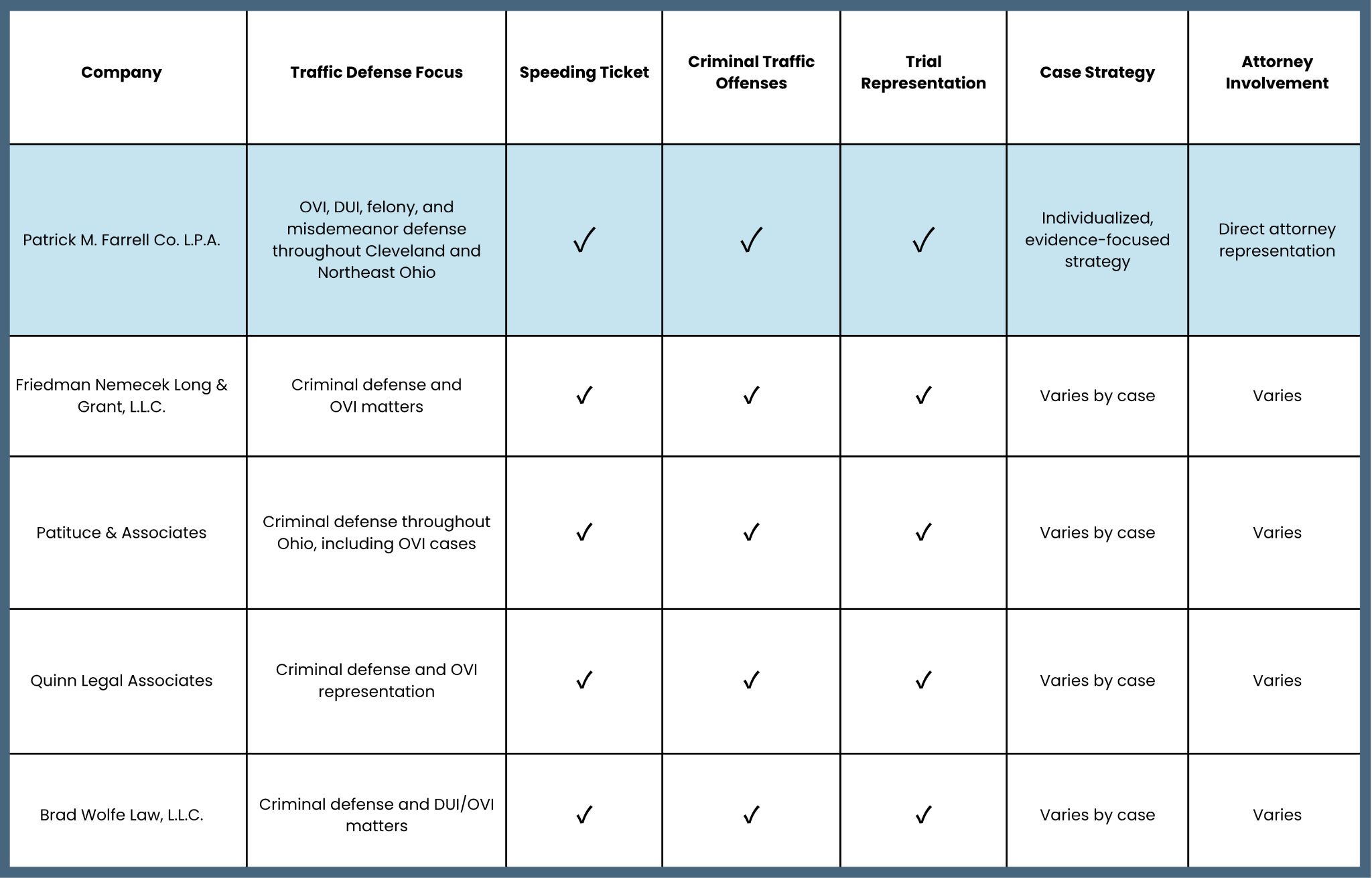
Note: This comparison is based on publicly available information and each firm's published services at the time of writing. Practice areas, staffing, consultation policies, fees, and client experiences may change. Anyone seeking representation should independently evaluate each attorney before making a hiring decision.
While every attorney approaches traffic cases differently, comparing factors such as evidence review, communication, courtroom preparation, and direct attorney involvement often provides a more meaningful comparison than advertisements or online ratings alone.
Patrick M. Farrell Co. L.P.A.
Many people assume a traffic ticket is simply about paying a fine. In reality, some traffic violations can have lasting consequences that affect your driver's license, insurance premiums, employment opportunities, and even your criminal record.
Patrick M. Farrell Co. L.P.A. represents drivers throughout Cleveland, Cuyahoga County, and Northeast Ohio in a wide range of traffic-related matters, from routine citations to serious criminal traffic offenses.
The firm regularly handles cases involving:
- Speeding violations
- Reckless operation
- Driving under suspension
- Hit-skip allegations
- Failure to stop after an accident
- Criminal traffic offenses
- OVI and DUI charges
- License suspension matters
Every traffic case begins with a careful review of the available evidence.
Some traffic cases involve far more than a simple speeding allegation. Depending on the facts, a defense strategy may require reviewing radar or LIDAR records, body camera footage, accident reports, witness statements, photographs, surveillance video, and constitutional issues surrounding the traffic stop. Looking at the evidence as a whole often provides a more complete picture than relying on the citation alone.
Traffic prosecutions rarely depend on a single piece of information. Police reports, body camera recordings, dash camera footage, radar or LIDAR evidence, witness statements, accident reports, surveillance footage, and constitutional issues may all influence how a case develops.
Rather than assuming the citation tells the complete story, Patrick M. Farrell Co. L.P.A. carefully evaluates each piece of evidence to determine whether factual disputes, procedural issues, or legal defenses may exist.
Depending on the circumstances, that process may include:
- Reviewing police reports
- Evaluating radar or LIDAR evidence
- Examining body camera and dash camera footage
- Investigating witness statements
- Reviewing accident reports
- Filing appropriate pretrial motions
- Negotiating with prosecutors when appropriate
- Preparing thoroughly for trial when necessary
Whether someone is facing a simple speeding citation or a criminal traffic offense carrying possible jail time, the firm's approach is based on the specific facts of the individual case rather than a one-size-fits-all strategy.
Common Mistakes Drivers Make After Receiving a Traffic Ticket
Many traffic cases become more difficult because of decisions made after the citation is issued rather than the violation itself.
Common mistakes include:
- Paying a ticket without understanding the long-term consequences
- Missing a required court appearance
- Ignoring license suspension notices
- Waiting too long to speak with an attorney
- Assuming every traffic violation carries the same penalties
- Posting details about the incident on social media
- Believing the police report cannot be challenged
Some drivers later discover that accepting a conviction resulted in license points, increased insurance premiums, or consequences they did not expect.
Understanding the potential impact of a citation before resolving the case can help drivers make more informed decisions.
Questions to Ask Before Hiring a Cleveland Traffic Ticket Lawyer
Every traffic case is different, and asking thoughtful questions during an initial consultation can help you compare attorneys more effectively.
Consider asking:
- How often do you handle traffic violations like mine?
- Who will personally appear in court?
- What evidence will you review?
- Are there legal defenses that may apply?
- What are the strongest and weakest parts of my case?
- What possible outcomes should I realistically expect?
- What does your fee include?
- Are you prepared to take the case to trial if necessary?
A lawyer's willingness to explain both the strengths and challenges of your case often provides valuable insight into how they approach representation.
Frequently Asked Questions About Hiring a Cleveland Traffic Ticket Lawyer
Should I Hire a Lawyer for a Traffic Ticket in Ohio?
It depends on the type of violation and the potential consequences. While some minor traffic tickets may be resolved without legal representation, citations involving criminal charges, license suspension, multiple points, commercial driver's licenses, or significant insurance consequences often warrant speaking with a traffic ticket lawyer before making a decision.
Can a Traffic Ticket Affect My Insurance Rates?
Yes. Depending on the violation and your driving history, a traffic conviction may increase insurance premiums. Insurance companies evaluate many factors when determining rates, and certain moving violations may remain relevant even after the court case has ended.
Will Points Be Added to My Ohio Driver's License?
Many moving violations carry points under Ohio law, although not every traffic offense does. Accumulating too many points within a specific period may result in additional penalties, including driver's license suspension. Understanding whether your particular citation carries points is an important part of evaluating your options.
What Happens if I Simply Pay the Ticket?
Many drivers do not realize that paying a traffic ticket is often treated as an admission of responsibility for the offense. Depending on the violation, this may result in points, insurance consequences, or a criminal conviction for certain traffic offenses. Before paying a citation, it is often worthwhile to understand the long-term consequences.
Can a Traffic Ticket Be Reduced or Dismissed?
Every case is different. Depending on the facts, the available evidence, and the applicable law, some citations may be reduced, resolved through negotiation, challenged in court, or dismissed. No attorney can ethically promise a specific outcome because every case depends on its own circumstances.
Will I Have to Go to Court for a Traffic Ticket in Ohio?
It depends on the violation. Some traffic citations can be resolved without appearing in court, while others require a mandatory appearance because of the seriousness of the offense or local court rules. An attorney can explain whether your particular citation requires you to appear.
What Happens if I Miss My Court Date?
Missing a required court appearance can create additional legal problems beyond the original traffic citation. Depending on the court and the type of offense, the judge may issue a warrant, suspend your driver's license, or impose additional penalties. If you miss a scheduled hearing, you should address the situation as soon as possible.
Can Commercial Drivers Fight Traffic Tickets?
Yes. Commercial driver's license holders often have additional concerns because traffic convictions may affect their employment, driving privileges, and future career opportunities. Even violations that appear relatively minor may carry significant professional consequences for CDL drivers.
Are Traffic Tickets Public Record in Ohio?
Many traffic court proceedings and convictions become part of the public record. Depending on the nature of the offense, a conviction may also appear during certain background checks conducted by employers, professional licensing boards, or insurance companies.
What Should I Bring to My First Consultation?
Bring any documents related to your citation or traffic stop, including:
- The traffic ticket or citation
- Court paperwork
- Accident reports, if applicable
- Photographs or videos
- Insurance information
- Witness contact information
- Any correspondence received from the court or Bureau of Motor Vehicles
Providing complete information allows your attorney to better evaluate the circumstances of your case.
Can I Change Lawyers During a Traffic Case?
In many situations, yes. A client generally has the right to change attorneys during a pending case, although the timing of the request and the stage of the proceedings may affect how the transition occurs. If you are considering changing representation, discuss how it could affect upcoming court dates and deadlines.
Choosing the Right Cleveland Traffic Ticket Lawyer for Your Case
No two traffic cases are exactly alike. The facts surrounding the stop, the available evidence, your driving history, and the nature of the alleged violation all play an important role in determining the best course of action. Taking the time to compare attorneys based on meaningful factors rather than marketing claims alone can provide greater confidence during an already stressful situation.
Whether you are facing a speeding citation, reckless operation charge, driving under suspension allegation, hit-skip investigation, or another traffic-related offense, understanding your legal options as early as possible may help you make better decisions throughout the case.
Comparing attorneys before making a decision allows you to better understand your options, evaluate how each lawyer approaches traffic cases, and choose representation that fits the facts of your situation.
Schedule a free consultation today with Patrick M. Farrell Co. L.P.A. Call or text 216-661-5050 or contact us online to discuss your case.

Why Choose Patrick M. Farrell Co. L.P.A.?
At Patrick M. Farrell Co. L.P.A., we prioritize your rights and freedom. Our experienced team is dedicated to providing you with personalized defense strategies that yield results.